

Most men can wear some kind of head covering again soon after a hair transplant, but not every style straight away. In the early weeks, a loose, light layer is far kinder to new grafts than a fitted cap or a firmly wrapped turban. The exact timing is your surgeon’s call, so treat any general guide as a starting point only.
This article explains why fit and friction matter, how to adapt a ghutra, shemagh or turban, and what to raise before the procedure.
Why does headwear matter so much after a hair transplant?
In the first days, each new graft is held in place by little more than the healing skin around it. The follicles have not anchored yet, so anything that presses, rubs or drags across them can disturb one.
Headwear can do all three. Two forces matter most:
- Pressure. A tight band, a firm wrap or a cord resting on the scalp squeezes the area where grafts are settling.
- Friction. Fabric that slides as you move, or as you pull a cap off, can catch on tiny scabs and tug at them.
Heat adds a third problem in the Gulf. A close-fitting covering traps sweat against the scalp, and warm, damp skin is not what a healing scalp needs.
The donor area deserves thought too. With DHI (Direct Hair Implantation), follicles are taken one by one from the back and sides of the head. That is exactly where a cap band or the lower edge of a turban tends to sit.
When can you wear a cap after a hair transplant?
Timings differ between clinics and between patients, and your own surgeon’s instructions always come first. As a broad picture, many clinics advise a gradual return:
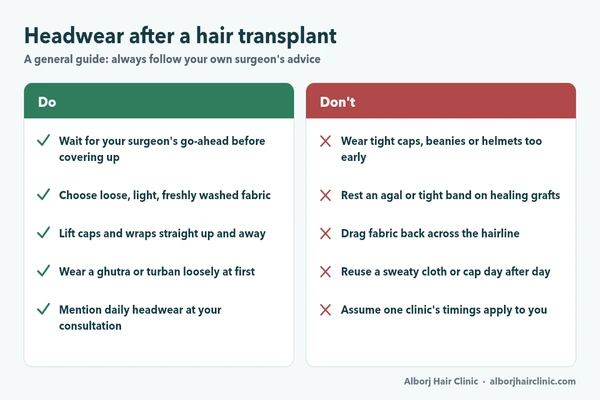
- The first few days. Many clinics advise keeping the head uncovered, or using only a very loose covering your surgeon approves.
- From around the end of the first week. A loose, clean hat is often allowed for short spells, as long as nothing presses on the grafts.
- Several weeks in. Snug baseball caps, beanies and helmets are often put off until the grafts have firmly settled.
Fitted caps with a tight strap are the ones to watch. Loosen the strap fully, or switch to a bucket hat or a soft, unstructured cap with room above the scalp.
How you take a cap off matters as much as how you put it on. Lift it straight up and away, rather than dragging it back over the hairline.
Can you wear a ghutra or shemagh after a hair transplant?
Often yes, with a few changes, and it is a common question in the Gulf. The cloth itself is light and loose, which works in its favour. The parts that need care are the agal and the cap worn underneath.
- The agal. The black cord sits in a ring around the head and holds the cloth with steady pressure. Ask your surgeon when it can go back on; until then, a draped or wrapped ghutra without it is a familiar style.
- The skullcap underneath. A close-fitting gahfiya or taqiyah rests directly on the scalp. A softer, roomier one, or none for a while, puts far less pressure on the grafts.
- Fresh fabric. Use a freshly washed cloth each day while the scalp heals, as sweat and dust build up quickly in the heat.
If you wear a shemagh, a loose drape is gentler than a tight twist. Keep knots and thick folds away from the treated areas.
What if you wear a turban every day?
For many men, a turban is a matter of faith and identity, not fashion. A good surgeon plans around it rather than expecting you to go without. Raise it at the consultation, so the aftercare plan fits your life from day one.
The challenge is that a turban is usually tied firmly, layer over layer, and its weight rests on the scalp. Adjustments men often discuss with their surgeon include:
- tying it more loosely than usual, with fewer layers, during the early weeks;
- using a soft, light under-layer instead of a tight inner band;
- unwinding slowly and lifting the fabric away, never pulling it across the scalp;
- changing to clean fabric often while the scalp heals.
Some men also time the procedure to fall before a stretch of leave, so the earliest days can be spent at home. Your clinic can say which approach suits the areas being treated.
“Many of my patients cover their heads every day, for work, for faith or simply for the sun. We talk about this before the procedure, so the aftercare fits their routine. In the first weeks, the aim is nothing tight, nothing heavy and nothing dragged across the grafts.”
How can you still look sharp while the grafts settle?
The early weeks call for soft cover rather than structure. Once your surgeon is happy with loose headwear, a few easy choices keep an outfit polished without pressing on the scalp:
- Bucket hats and roomy caps in cotton or linen, which breathe better than heavy synthetic fabric.
- A loosely draped ghutra in crisp white or a soft pattern, which reads as deliberate rather than makeshift.
- Sunglasses and a strong collar, which draw the eye down towards the face.
- Neutral tones that match your usual workwear, so the covering does not stand out.
For the office, it is worth a quiet word with your manager about a short-term medical change. A neat, loose covering in a shade that matches your suit or kandura looks considered rather than temporary.
About Alborj Hair Clinic
Alborj Hair Clinic is a hair transplant clinic in Mazaya Centre, Al Wasl, Dubai. Its surgeon, Dr Dimitrios Ziakas, has 24 years of experience and has performed more than 4,000 hair transplant procedures. He is a member of the International Society of Hair Restoration Surgery (ISHRS) and uses the DHI (Direct Hair Implantation) technique.
Men who wear a ghutra, shemagh or turban every day can raise it with Alborj before booking.
The clinic’s website also features before-and-after case studies from its patients.
Frequently asked questions
Can I wear a hat to hide the scabs?
Often, but only a loose one, and only once your surgeon agrees. A tight hat presses on and rubs against new grafts, which is the opposite of what they need.
Is a loose ghutra gentler than a cap?
Usually, as less pressure is better in the early weeks. A draped cloth without a tight skullcap or agal underneath tends to be the gentler choice, but check with your surgeon.
When can I wear a motorbike or cycling helmet?
Helmets press firmly on the whole scalp, so many clinics advise waiting several weeks. Ask your surgeon before you ride again.
Does covering up protect a healing scalp from the sun?
A loose, light covering can help shade the scalp in strong sun. Your clinic will tell you when and how to cover up safely.